Press play. The current line shows up here with its translation.

No transcript yet.

Captions in your language

If YouTube has captions for this video, turn them on with CC in the player. To read them in your language, open the video on YouTube and choose Settings, Subtitles, Auto-translate.

Open on YouTube

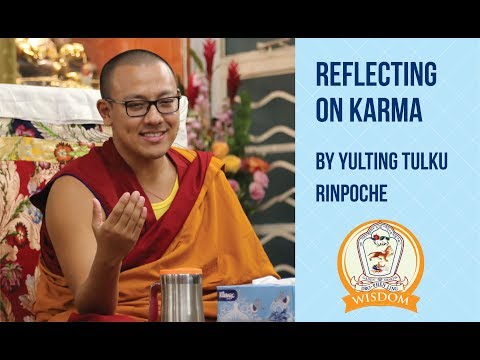
How to Reflect on Karma in Our Everyday Lives by Yulting Tulku Rinpoche

Feb 7, 2019Spoken in EnglishQ&AVajrayana

DescriptionThe reason why we indulge in more bad deeds than good, is because we think only of the short-term satisfaction. We get swayed by our afflictive emotions. If we really want to be truly happy, we should take a long-term view - reflect on the law of cause and effect, and recognise the causes of our sufferings. In this seMore
The reason why we indulge in more bad deeds than good, is because we think only of the short-term satisfaction. We get swayed by our afflictive emotions. If we really want to be truly happy, we should take a long-term view - reflect on the law of cause and effect, and recognise the causes of our sufferings. In this session, Yulting Tulku Rinpoche shared with us many different methods that one could reflect on our actions (karma) in our everyday lives. #karma #causeandeffect #yultingrinpoche This teaching was organised by Gaden Shartse Dro-Phen Ling (GSDPL), in Singapore, on the 9th Jan 2019. Follow our activities on our Facebook page: https://www.facebook.com/drophenling/ Or get to know us from our website: http://www.drophenling.com/about-us/introduction/ . . During the question and answer session, members of the audience asked the following questions: 1) What is the thing that brings our karma imprints from one life to another? 2) How do I not gossip in office? Because if I don't gossip, I will feel left out by my colleagues. 3) What if I commit killing unknowingly? What do I do? 4) How do I contemplate deeper on suffering, in order to practice better. 5) Is taking probiotics considered killing - a non-virtue action? Is it okay to take them?

Terms in this video

karma
Intentional action of body, speech or mind and the force it leaves behind.
suffering
Pain and the unsatisfactory quality of all conditioned experience; the first noble truth.
cause
The main cause of a result; in Theravada Abhidhamma, also the wholesome and unwholesome roots.

How other traditions teach karma

Theravada27,175 videos

Mahayana23,804 videos

Secular28 videos

Across traditions1,805 videos

All teachings on karma

Keyboard shortcuts

jk
Move selection down / up
Enter
Open selection
/
Search
l
Watch later (selection or current video)
Space
Play / pause (watch page)
?
Show this help
Esc
Close / leave the search box